Why Another Recession Is Coming – In English

Friends, here is a tutorial on how we got here and how to prepare for the worst.

ssminnow
Easy Money

The Federal Reserve (Fed) offered Quantitative Easing (QE) 3 times.  At first it saved the big banks and the stock market started going up.  But then the Fed kept giving out easy money to the big banks.

Leveraged Loans and Junk Bonds

The banks, that received the QE money, issued junk bonds and leveraged loans that were used for debt creation not real products and services.  Specifically QE went to Mergers and Acquisitions (M & A) and oil investments.  Here is an example.

Richard Baker, chief executive, along with his investment firm, NRDC Equity Partners, relied heavily on borrowed [leveraged loan] money. Of the $1.2 billion that it paid for Lord & Taylor, only $25 million [2%] came in the form of equity, with the remainder made up of debt financing. [The New York Times]

Do you think any of us could buy a house with 2% down? Nope.

New Bubbles

For 2014, three things happened.  The dollar reached a new record high, the Dow Jones hit a record 32 times and leveraged loans went back to 2008 pre-recession levels.  Some economists are calling this a bubble.  Here is a chart to prove it.

See https://michaelekelley.com/2014/12/20/leveraged-loans-predict-crash/

Some Good News

The good news is the stock market is up, gas prices are low and unemployment is back to 2003 levels.

But the Economy Struggles

The economy is struggling for several reasons.  First, the easy money went into debt rather than real products which creates jobs.  Secondly, very little money went into infrastructure which also creates jobs.

And Wage Inequality Is Greater Than Ever

The CEO to worker compensation ratio is 296 to 1 today versus 20 to 1 in 1965.   The rich have gotten richer.  Unfortunately the upper class does not change its spending patterns.  Several studies have proved this despite what politicians say.

So the economy has stalled even though the stock market is up.  Only the middle and upper classes have money to invest in the rising stock market.

Oil Price Drops and Leveraged Loan Bubble Bursts

Oil prices have dropped because of excess supply and over-leveraged oil investors.  For more information see this easy to understand website.

http://wolfstreet.com/2014/12/07/bloodbath-in-oil-patch-junk-bonds-leveraged-loans-defaults/

Solutions for the Federal Reserve and Congress

Here are some solutions because blogs should offer solutions rather than just complain about our problems.

There is still time for the Federal Reserve to pump up the economy by providing funding specifically for infrastructure which will create jobs and kick start the economy.  Also Congress, or better yet, each state can raise the minimum wage.  The economy will only take off if new jobs are created or lower class or middle class people get pay raises.

Here is a list of 7 suggestions that will not soak the rich.

http://www.marketwatch.com/story/7-ways-to-help-the-middle-class-without-soaking-the-rich-2015-02-05?page=1

But if the government drags its feet or does more of the same Quantitative Easing, here is what you can do to prepare for the worst.

Solutions for the Rest of Us

https://michaelekelley.com/2014/10/16/8-things-to-do-when-recession-happens/

Lessons From How The Great Recession Happened and What A CDO Is

http://www.ase.tufts.edu/gdae/Pubs/te/MAC/2e/MAC_2e_Chapter_15.pdf

Good luck!

Remember CDOs? They’re Baaaack!

Like Poltergeist II, prepare for CDOs II.

poltergeistII

(Here is Poltergeist II trailer –  https://www.youtube.com/watch?v=rH-B6A04iK0 )

Remember those financial instruments known as Collateralized Debt Obligations that caused the 2008 Great Recession?  Well they never went away.  In fact they are baaack.

The Financial Crisis Inquiry Commission concluded that CDOs were one of the major causes of the 2008 Great Recession as shown at this website.

http://fcic-static.law.stanford.edu/cdn_media/fcic-reports/fcic_final_report_conclusions.pdf

For 2014, global CDO Issuance is back to 2004 levels valued at about $135 billion.

Collateralized loan obligations (CLOs) are CDOs based on bank loans. Many of the subprime loans have been packaged and sold as CLOs.

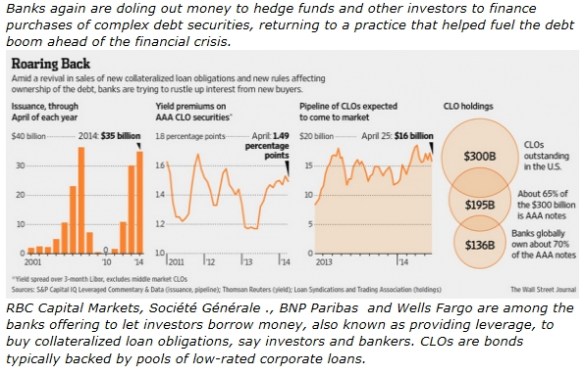
The following chart shows that Collateralized Loan Obligations (CLOs) in 2014 have reached the same level as 2007 or $35 billion.  Total outstanding CLOs in the US amount to $300 billion.

clo_banks

Though the large financial institutions have backed away from collateralizing mortgages, they are now doing it for commodities such as gold, silver and oil.  Here is one example.

https://www.google.com/search?q=jpmorgan+precious+metals+as+collateral&ie=utf-8&oe=utf-8


http://theeconomiccollapseblog.com/archives/plummeting-oil-prices-destroy-banks-holding-trillions-commodity-derivatives


Another problem is not the collateral but the reselling of the same assets. In 2007 one financial firm sold 610 out of 3,400 CDOs more than once. That is nearly 18%.  Let me repeat.  More than once.

Because buyers are dealing with paper not physical assets, how do they know they are trading real, actual commodities? If the markets started to go down and everyone wanted their physical commodities such as gold, what if there was not enough gold to meet all the obligations?  Would there be an international panic?

Update
Evidently CDOs were not selling as well as desired.  So the banks have renamed them “bespoke tranche opportunities.”

BTOs are slightly different, as explained in this website.

http://thinkprogress.org/economy/2015/02/05/3619325/bespoke-tranche-opportunities-are-your-god-now-america/?utm_source=newsletter&utm_medium=email&utm_campaign=tptop3

Thanks


Leveraged Loans Predict 2015 Crash

Multiple charts exist which predict another recession soon!

us_overleveraged_201501


Normally I am a very positive person.   But recently I found not one but two charts which show we could have a repeat of the recent Great Recession.

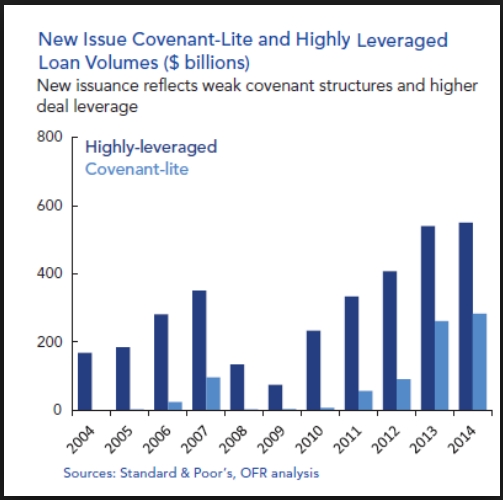
The first chart above shows how the Federal Reserve and Quantitative Easing have allowed financial institutions to run wild again.  In summary, leveraged lending is out of control.   For two years, leveraged loans have risen as fast and to a greater level than 2007, the year before the Great Recession.

The New York Times reports that leveraged lending is greater and the associated rules more lax than in 2007.  Here is a portion of a news report.

What can’t be denied, however, is that standards in the leveraged loan market have become much looser in recent years. The companies that have taken out the loans are on average much more indebted than in recent years. Companies that have done deals this year have debt that is 4.9 times as large as their annual cash flows, measured using earnings before subtracting expenses like interest, taxes and depreciation, according to data from Standard & Poor’s Capital IQ. That multiple is up from 3.9 times in 2011 — and it is the same as the number for 2007, when the last boom in leveraged loans peaked.

This time around, however, one aspect of leveraged lending is much more aggressive. The special provisions within loan agreements that were once thought crucial for protecting creditors are fast disappearing. So far this year, 63 percent of leveraged loan deals lack such provisions, far higher than 25 percent in 2007, according to data from S.&P. Capital IQ. “Contractually, things are really at their weakest,” said Christina Padgett of Moody’s Investors Service.

You can read more details at one of these websites:

http://dealbook.nytimes.com/2014/11/04/a-recent-surge-of-leveraged-loans-rattles-regulators/?_r=0

http://www.zerohedge.com/news/2015-04-09/oil-hedges#comment-5977321

http://www.bloomberg.com/news/2015-01-06/private-equity-deals-spur-leveraged-loan-surge.html

~~~~o~~~~

A second chart shows that recent Dow Jones record increases also occurred in 2008.

http://en.wikipedia.org/wiki/List_of_largest_daily_changes_in_the_Dow_Jones_Industrial_Average

Unfortunately 10 out of 20 increases of 400 or more of the Dow occurred in 2008, the year of the last recession

~~~~o~~~~

Can another Great Recession be stopped?  No.  Apparently the Federal Reserve did not act fast enough nor aggressive enough in 2014 to stop the out of control leveraged loans.

To protect yourself, read this website:

https://michaelekelley.com/2014/10/16/8-things-to-do-when-recession-happens/

Thanks for reading this.

8 Things To Do When Recession Happens

Yeah it is not a matter of IF but WHEN the next recession will happen.  Sorry.  You could go ride a roller coaster to get your mind off of it.  Or you could do these things.

rollercoaster

Recessions occur every 4 to 8 years in a society with capitalism and little regulation.  And since the last one was in 2008….

Here’s what you should do.

1. DON’T PANIC – Stay calm.  Most people will be doing one thing – panicking. You won’t.

2. THINK, THINK, THINK – Be smarter than the rest. Know when to sell, when to buy and, like Kenny Rogers, when to hold.

3. SET UP ALERTS – Get an E*Trade or other brokerage account and set up messages when Dow (DJIA) goes up 3% or goes down 3% in a day.

4. RECALIBRATE AT NOON EASTERN TIME – If you have time, think about your next sell or buy of what and for how much before the market closes.

5. IF UP, SELL – When there is a jump up in stocks, sell your stock and funds 25-35% at a time.  You may have to wait to use the money.   Time is on your side.

6. IF UP AND GOLD IS DOWN, BUY GOLD – Gold usually moves opposite of stocks, so buy gold or gold mining funds such as NEM which will move up when stocks crash.

7. IF UP, BUY SHORTS – Shorts are stock buys that you expect to go down.  Pick losers on purpose.  Also choose bearish ETFs such as PILS and TECS that rise if the stock price of pharmaceutical or tech companies goes down.

8. IF DOWN, WAIT – Remember we agreed to not panic.

There will be four 400+ gains or losses of the DOW before a recession happens.  Anybody can take advantage of them. And I know you will. (There have been 4 days in August and September 2015 with over 400 point ups and downs.)

Or you can go ride a roller coaster to get your mind off of the market’s ups and downs.

P.S. I care about you, but can’t be held responsible for your results.

Revised: 04/10/2016 DUG is volatile since oil producers are considering fixing output quantities.

Central Bank of Central Banks Warns Of Crash

The Bank for International Settlements, BIS, warns that silence is NOT golden.

golden-gun-hd-wallpapers

The BIS has been warning for years of the dangers of very low interest rates.

“A common mistake is to take unusually low volatility and risk spreads [aka silence] as a sign of low risk when, in fact, they are a sign of high risk-taking,” said Claudio Borio, head of the monetary and economic department at the BIS.

Borio added that the last time uncertainty was this low was in 2007 just before one of the largest forecast errors the economics profession has ever made [aka Great Recession].

Now the BIS has warned the world again.  This time with specifics.

The BIS said 55% of collateralised debt obligations (CDOs) now being issued are based on leveraged loans, an “unprecedented level”. This raises eyebrows because CDOs were pivotal in the 2008 crash. “Activity in the leveraged loan markets even surpassed the levels recorded before the crisis: average quarterly announcements during the year to end-September 2014 were $250bn,” it said.

See the following link for more information.

http://www.marketwatch.com/story/low-volatility-is-a-sign-of-high-risk-taking-bis-official-says-2014-09-14?siteid=nwham

Does the BIS have to get out its big guns to make its point?

Home Equity Bubble To Burst

Homeowners, that are PAYING ONLY INTEREST, are in for a shock.

home_equity_bubbleMany people bought homes during the crazy days before the Great Recession.  Many of them have been paying only interest on those mortgages.  Now their payments are about to jump up to include the principal.  Many people will have their house PAYMENT DOUBLE!

The number of homes involved constitutes a bubble as seen in the graph above.

For 2014 about $22 billion worth of homes are involved in home equity loans.  If the average house is $215 thousand, then that means a little over a 100 thousand homes are involved.  That is about 2.5% of the current home sales.

For 2015 the amount of home equity loans involved doubles from the previous year.  Thus over 200 thousand homes could be involved or about 5% of current home sales.

This could result in a lot of foreclosures again if they are not refinanced.

Then with Quantitative Easing ending by January 2015, we could see a return of cash payments to normal levels which could result in a 10% drop in home sales.

The 5% increase in home inventory combined with a 10% drop in buyers could be a double whammy to the housing recovery.  Let’s hope for the best.

Another Shocking Chart Predicts 2014 Crash

Multiple charts exist which predict another recession this year!

net_margin_bubble

Now, I am normally a very positive person.  In fact my first post for the new year was very hopeful.  But recently I found not one but two charts which show we could have a repeat of the recent Great Recession.

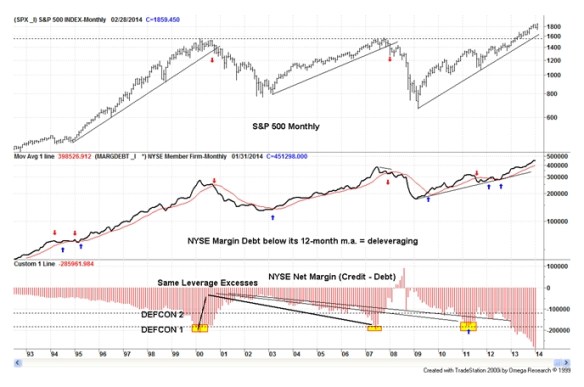
The first chart above shows how the Federal Reserve and Quantitative Easing have allowed Credit to run wild again.  In summary, the Net Margin (Credit minus Debt) is out of control.   For the past year it has risen as fast and to the same level as the year before the 2008 Great Recession.  Daniel Fisher of Forbes reported this as found by Ricardo Ronco of Aviate Global.  Ronco says, “…equities are running away from borrowing levels.”

How do we fix this bubble? We convince the Federal Reserve to issue loans to cities and states rather than financial institutions that only buy stocks and bonds. Cities and states will use the money for infrastructure which will create jobs.

Here is another prediction for the S&P 500 to drop 30%.  See http://blogs.marketwatch.com/thetell/2014/04/03/sp-500-will-peak-around-1900-to-1950-then-drop-30-saxo-bank-strategist/

But based on the above chart, I predict a drop of 50% not merely 30% in the S&P 500.

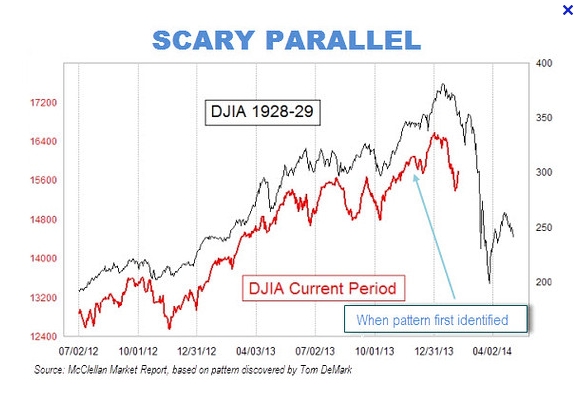
scary_djia_chartThe second chart above shows how the Dow Jones Industrial Average (DJIA) is the same as 1929.   It has followed almost identically as it did in the years leading up to the Great Depression in 1929.

Big name investors like Warren Buffet and George Soros have cut their stock investments or shorted the market.

If another Great Recession occurs, riots will take place that are greater than the Occupy Wall Street demonstrations and President Obama will face impeachment.

Can another Great Recession be stopped?  Yes, the Federal Reserve can take two actions.

1. Put restrictions on QE funds to minimize leveraged lending.

2. Stop issuing QE funds to institutions that use “expected rent” as collateral.

You can make a difference by voting for the following White House Petition.

wh.gov/lQLCi

Thanks for reading this.

Shocking Charts Predict 2014 Crash

Multiple charts exist which predict another recession this year!

leverage_loan_chart

Now, I am normally a very positive person.  In fact my first post for the new year was very hopeful.  But recently I found not one but two charts which show we could have a repeat of the recent Great Recession.

The first chart above shows how the Federal Reserve and Quantitative Easing have allowed financial institutions to run wild again.  In summary, the leveraged lending is out of control.   For the past year it has risen as fast and to the same level as the year before the 2008 Great Recession.

scary_djia_chartThe second chart above shows how the Dow Jones Industrial Average (DJIA) is the same as 1929.   It has followed almost identically as it did in the years leading up to the Great Depression in 1929.

Big name investors like Warren Buffet and George Soros have cut their stock investments or shorted the market.

If another Great Recession occurs, riots will take place that are greater than the Occupy Wall Street demonstrations and President Obama will face impeachment.

Can another Great Recession be stopped?  Yes, the Federal Reserve can take two actions.

1. Put restrictions on QE funds to minimize leveraged lending.

2. Stop issuing QE funds to institutions that use “expected rent” as collateral.

You can make a difference by voting for the following White House Petition.

wh.gov/lQLCi

Thanks for reading this.